Satta Matka Mumbai Bajar – : The mission of the Department of Health and Medical Education is to provide quality and cost-effective medical services to all residents of Jammu and Kashmir. Healthcare in J&K has improved significantly due to the funding and filling of gaps in human resources and healthcare infrastructure by the Ministry of Health and Family Welfare of India, which is working to improve healthcare across the Union Territory of Jammu and Kashmir.
The field of medical education has been strengthened and improved in order to provide better medical information to the general public. As more students are able to enroll in medical and nursing schools, both the supply and demand for human resources will benefit. The LG administration’s efforts to improve healthcare in J&K and make it more affordable and accessible have led to improved health indicators in the state.
Satta Matka Mumbai Bajar

Efforts were made to improve primary health care, including turning the district hospital into a specialized department, to reduce the burden on tertiary care hospitals. In short, health is the ultimate goal for everyone.
Satta Matka Tp Pana (panel/patti) Chart By Smt Official
Health insurance for all residents of J&K, a universal health care program by the Government of India in association with Ayushman Bharat PMJAY with a special focus on reducing out-of-pocket costs for the poor and economically vulnerable population.
Patients can access medical services from 26,137 private medical facilities and public hospitals and clinics across the country. Our people in remote mountainous areas and rugged terrains will always have access to the best healthcare and we will never compromise on this promise.
The mandate of the Jammu Directorate of Health Services is to ensure that all hospitals and clinics in the Jammu region provide essential preventive, palliative and curative care. The Health Department is headed by the Director of Health Services, Jammu Division. This department consists of 10 districts. Each administrative unit is supervised by a chief physician. The Director of Health Services, Jammu exercises direct administrative control over all the Chief Medical Officers. There are health blocks in each district, each of which is headed by a medical doctor under the direct supervision of the chief doctor. Block Medical Officers are responsible for each health block.
With the help of medical staff in hospitals and clinics across Jammu and Kashmir, the Directorate of Health Services (DHS) in Jammu and Kashmir (J&K) aims to provide the best healthcare services to its citizens.
Kalyan Matka Result Main Bazar By Satta Matka
The organization lives by the principle that the greatest service to humanity is service to others.
Reverend Robert Clark founded the Kashmir Medical Mission. A medically trained woman is responsible for introducing western medicine to the valley. On his return from a missionary tour of Kashmir, Ladakh and Skardu, Mr. Clark was able to secure the support of a medical mission in Kashmir from several prominent British citizens and officials, including Mr. Robert Montgomery, the then Governor of the Punjab. Only fourteen thousand rupees were collected to organize a medical mission in Kashmir. After hearing of the plan to establish a medical mission in Kashmir, the Lieutenant Governor sent an invitation to the Missionary Society (CMS) and personally contributed one thousand rupees. In 1865, the first medical missionary of the Christian Medical Society (CMS), Dr. William Elmsley, arrived in Kashmir. He was the son of a shoemaker in Aberdeen and received a Master of Arts degree from the University of Aberdeen and a medical degree from the University of Edinburgh.
In the summer of 1865, Dr. Elmsley saw about 2,000 patients. At that time, no Europeans were allowed to spend the winter in the valley. Due to the strong official distaste for the missionary component of CMS’s medical activities, in 1866 after his return, Dr. Elmsley could not find adequate accommodation. But in the spirit of a Scotsman who never gives up, he treated 3365 patients at the same time. a tent that became both outpatient and inpatient. Until 1869, Dr. Elmsley spent every summer in the Kashmir valley, where he treated hundreds of patients and helped to prevent a devastating outbreak of plague.

In 1870 Reverend W.T. Storrs was in charge of the Kashmir Medical Mission. When Dr. Elmsley returned to Srinagar in 1872, the city was in the midst of another devastating plague. His health failed and he died on the way home in the fall of 1872.
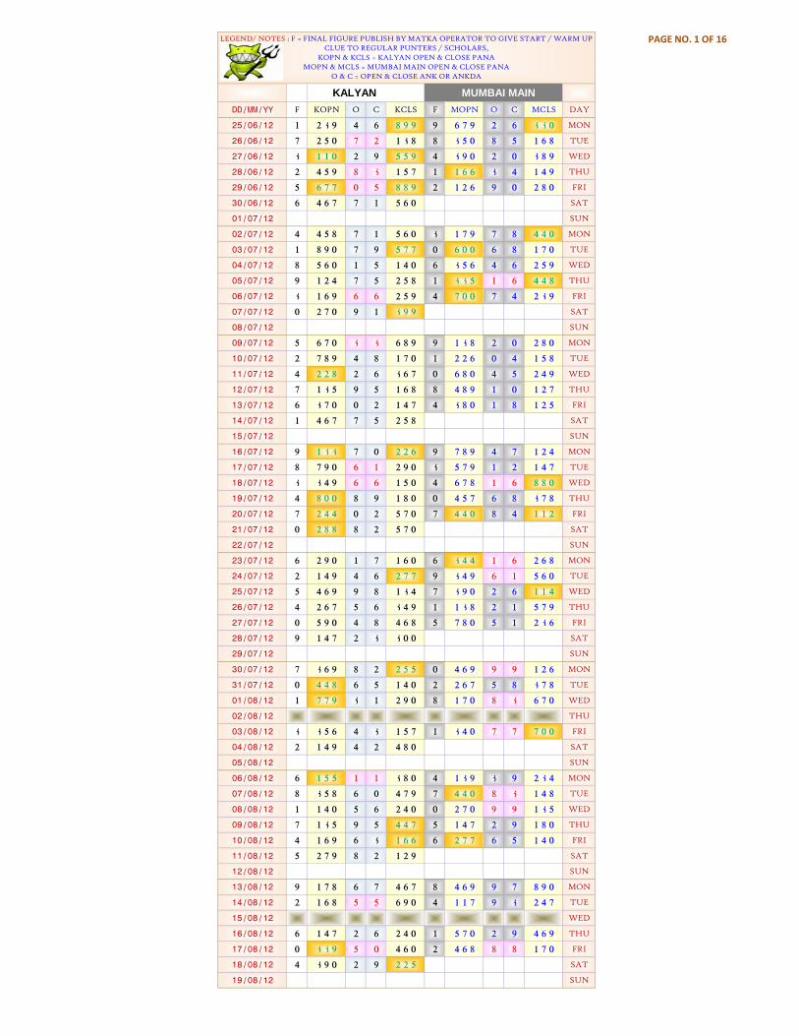
Satta Matka Kalyan Chart
The medical mission was started in 1874. under favorable conditions, thanks to Dr. Theodore Maxwell, who succeeded Dr. Elmsley. The government’s objection was overruled and Maharaja Pratap Singh was allowed to build a hospital at Rustam Garh in Drugjan. Dr. Maxwell worked for two years in a modest structure provided by the state until his health failed and he was forced to leave India.
In 1995, the Ministry of Health and Family Welfare established a separate department of Ayurveda, Yoga and Naturopathy, Unani, Siddha and Homeopathy (AYUSH) for Indian Systems of Medicine and Homeopathy (ISM&H). Ayurveda, Yoga, Naturopathy, Siddha, Unani and Homeopathy are legally recognized systems and the role of this department is to encourage and promote their use. This has been done with the full understanding of the benefits that these sophisticated and ancient techniques can bring to human health. These systems provide preventive and preventive treatments and are much more effective in combating chronic diseases.
Sustainable Development Goal (SDG) 3.8: The goal of the Jammu and Kashmir State Health Agency is to provide financial security to avoid catastrophic health costs and ensure access to quality health care for all. The people of Jammu and Kashmir can realize their full potential for health and happiness at every stage of life. Jammu and Kashmir State Health Agency aims to be “a trusted government agency to achieve the Sustainable Development Goals (SDGs) i.e. Universal Health Coverage (UHC) as defined by the World Health Organization (WHO).
The Department of Health Services engages TB workers at the divisional and district levels to achieve program goals. It is expected that by 2025, tuberculosis will be completely eradicated. The two largest hospitals in the region that treat TB patients are the Chest Diseases (CD) Hospital in Jammu and the CD Hospital in Srinagar.
Satta Result 2023: Winning Numbers For April 16 Satta Matka, Ghaziabad Satta King, Gali Satta King, Faridabad Satta King, Disawar Satta King
NLEP (National Leprosy Eradication Program) was established in 1983. NLEP’s mission is to eradicate leprosy by providing all necessary medical care, including treatment for leprosy-related disabilities, free of charge and at a convenient location for the public. The National Leprosy Eradication Program (NLEP) is a National Health Service (NHS) initiative managed by the Regional Leprosy Officer at ward level with district assistance.
The 12th Five Year Plan approved the NRCP, which includes provisions on human and animal health. The NRCP hopes to eliminate Rabies as a cause of death by 2030. Based on this initiative, victims of dog bites or animal attacks will have access to vaccines and serum.
IDSP stands for Integrated Disease Surveillance Program and is a state-wide, decentralized surveillance program. Its main task is to identify epidemics in their early stages so that a faster and more effective response can be made. Objectives include early detection and response to outbreaks by a trained rapid response team and IT-based disease surveillance systems in a decentralized laboratory for strengthening and maintaining Epidemic Diseases (EPDs).

2020 in the union territory of J&K. On March 24, the then lieutenant Sh. Sh. G.C.Murmut, after receiving a free call on 108 and 102, provides emergency medical assistance and sends an ambulance to the scene.
Satta Matka Result Time Bazar Apk For Android Download
During the development of national quality assurance standards, the special needs of public health institutions and international best practices were taken into account. NQAS is now available for District Hospitals, PHCs, PHCs and City PHCs. The main purpose of the standards is to help service providers measure their quality against established standards and bring their equipment to a level where they can be certified.
Rashtriya Kishore Swasthya Karyakram (RKSK) was established in 2014 by the Ministry of Health and Family Welfare. 7 January to all 253 million teenagers in India, regardless of their gender, location, marital status, education level or employment status.
A new program of the Ministry of Health and Family Welfare aimed at promoting menstrual hygiene is aimed at adolescent girls (10-19 years old) in rural areas.
Menstrual hygiene education for adolescent girls and access to high-quality sanitary napkins are two key areas of the program in rural areas.
Satta Matkà Chart
The Ministry of Health and Family Welfare (GOI), Government of India, launched MeraAspataal (My Hospital) to collect feedback from patients on the quality of care they received from government hospitals, and private hospitals were allowed to participate in the program. Short Message Service (SMS), Outgoing Call (OBD), Mobile App and Web Portal are just some of the ways to communicate with users. The software provides a central location for collecting comments, detailed analysis and sharing results with others.
Regional
Main mumbai matka satta, satta bajar, satta matka mumbai chart, satta matta matka, satta matka main mumbai open, satta matka, satta matka mumbai chat, satta matka mumbai guessing, mumbai matka satta, matka bajar, matka satta bajar, satta matka men mumbai