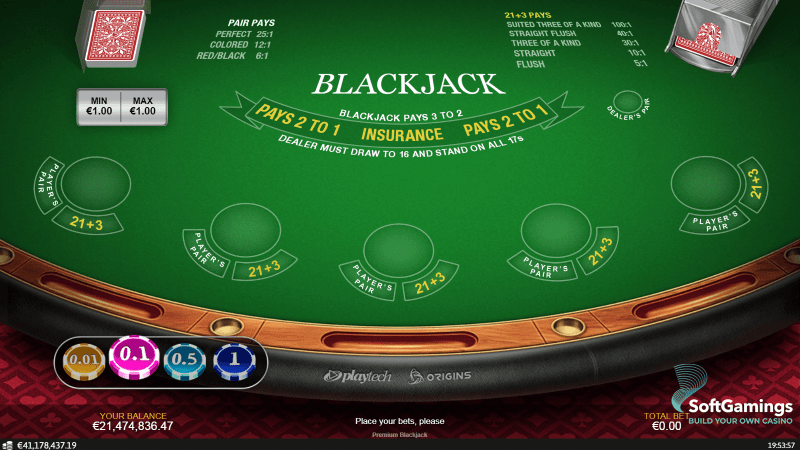
Blackjack – Card counting is a blackjack strategy used to determine whether the player or dealer has an advantage on the next hand. Card counters are profitable players who try to control the casino house edge by keeping count of high and low value cards. They usually bet more on their advantage and less on the dealer’s advantage. They also change play decisions based on deck composition.
Card counting is based on statistical evidence that high cards (aces, 10s, and 9s) favor the player, while low cards (2s, 3s, 4s, 5s, 6s, and 7s) favor the dealer. Secondary cards suit the player in the following ways:
Blackjack

On the other hand, minus the dealer’s suit card. The rules require the dealer to hit a hard hand (12-16 total), and with fewer cards the chances of breaking those totals are less. A dealer keeps a stiff hand if the next card is a 10.
Top 20 Blackjack Games For Mobile
Counter cards do not require extraordinary metal capacity; They do not track or remember specific cards. Instead, card counters assign each card a point score that approximates that card’s value. The sum of these values is followed by a running count.
The myth that follows each card was shown in the 1988 film Rain Man, where the savant character Raymond Babbitt easily counts through six decks, and a casino employee says it is impossible to do.
Basic card counting systems assign each card a positive, negative, or zero value. How a card is dealt, the count is adjusted by the count value of that card. Low cards increase the count; They increase the number of secondary cards in the deck. Higher cards decrease the count for the opposite reason. For example, the Hi-Lo system subtracts one for every 10, Jack, Q, King, or Ace and adds one for any card between 2 and 6. 7s, 8s, and 9s are counted as zeros and do not affect the count.
The purpose of a card counting system is to provide point values roughly related to the efficiency of card removal (EOR). EOR is the expected effect of removing a giv card from play. Counters measure the effect of removal for all four treated and how it affects the edge of the court. Larger ratios between point values correlate better with actual EOR, increasing the efficiency of a system. These systems are classified as Level 1, Level 2, Level 3 and so on. The level corresponds to the ratio between the values.
How Does Live Dealer Blackjack Work?
The hi-lo system is a level-1 count; A run count is never incremented or decremented by one. A multi-level count, such as Z Count, Wong Halves, or Hi-Opt II, further separates the card values to increase accuracy. An advanced count includes values such as +2 and -2, or +0.5 and -0.5. Advanced players can also keep a side count of special cards such as aces. This is done where the accuracy of betting is different from the accuracy of play.
Many spot counting techniques exist, including special counting used for non-standard profitable play options such as over/under betting.
Keeping track of more data and higher level counts can hurt speed and accuracy. Some counters make more money by playing simple numbers quickly rather than playing complex numbers slowly.

The primary purpose of a card counting system is to assign a point value to each card that is roughly based on the card’s “removal effect” or EOR (ie, the effect on the house advantage after a card is removed from play. ), such as a. Allowing the player to determine the house advantage based on the composition of the cards should always be addressed. Larger ratios between point values may better correlate with the actual EOR, but may add complexity to the system. The numbering system may be referred to as “Level 1”, “Level 2”, etc., corresponding to the number of different point values required by the system.
How To Play Evolution Gaming Blackjack ?
The ideal system is the system that can be used by the player and offers the highest average dollar income over time settled at a fixed rate. With this in mind, the system aims to achieve a balance of efficiency in three categories:
When the sum of all undealt card suits gives a player a positive expectation using the optimal playing strategy, a player has a positive expectation to make a bet. A system’s BC measures how effective a system is at notifying the user of that condition.
Part of the potential benefit comes from modifying the playing strategy based on the known changing composition of the cards. For this reason, the PE of a system measures how effectively it informs the player to modify the strategy according to the current composition of undealt cards. A system’s PE is important when the effect of PE has a large impact on total profit, such as in single and double-deck games.
Part of the potential profit in card counting comes from insurance bets, which become profitable in high numbers. An increase in IC will offer additional value to a card counting system.
Logo Poker And Blackjack Royalty Free Vector Image
Some strategies count aces (ace-reckoned strategies) and some don’t (ace-net strategies). Including the ace in the count improves the betting relationship because the ace is the most valuable card in the deck for betting purposes. However, since an ace can be counted as either an ace or an ale, including an ace in the count reduces playing efficiency. Because PE is more important in single- and double-deck games, and BC is more important in shoe games, the number of aces is more important in shoe games.
One way to deal with such a trade-off is to ignore the ace to get a higher PE while keeping a side count that is used to detect an additional change in EV that the player uses to detect additional betting opportunities that will be made for those who would not. normally represented by a primary. Card counting system.
The most common side card is the Ace because it is the most important card in terms of achieving BC and PE balance. In theory, a player can keep the side count of each card and get almost 100% PE, however, the way to add additional side count to PE becomes more complicated at an exponential rate as you get more Combine side count and human brain capacity. Quickly becomes overwhelmed and cannot do the necessary calculations. Without counting the sides, the PE can reach 70%.

Because using a card counting system has the potential to create an overtaxing demand on the human brain, another important design consideration is ease of use. High level systems and systems with side counts will obviously be more difficult and in an attempt to make them easier, unbalanced systems eliminate the need for a player to keep tabs on the number of cards/decks already in play. game in reducing PE.
The Mathematics Of Blackjack
The actual count is the sum total of the value of each card dealt. Using a balanced count (such as the Hi-Lo system), the running count is converted to a “true count”, which takes into account the number of batteries used. With Hi-Lo, the correct count is the number of runs divided by the number of untreated batteries; It can be calculated by division or approximated by multiplying the number of rounds faced by the average card count per round. However, many variations in the exact count calculation exist.
This section requires additional references for verification. Please help improve this article by adding references to reliable sources in this section. Unsourced content may be challenged and removed. (June 2021) (Learn how and who to remove this message template)
Back-counting, or “wonging,” involves standing behind a blackjack table and counting the cards as they are dealt. Stanford Wong first introduced the idea of counting backwards, hence the name.
The player will enter or “win” the game when the count reaches a point where the player has an advantage. The player can increase their bets when the odds increase, or decrease their bets when the odds decrease. Some back-counters prefer to bet flat, and only bet the same amount once the game is over. Some players will stay at the table until the game changes, or they may “wong out” or leave when the count reaches a level where they have no advantage.
Black Jack For Nintendo Switch
Countdown is done on 4, 6, or 8 game shoe piles, although it can be done on 1 or 2 game pitch piles. This is because the count is more stable in the shoe game, so a player is less likely to sit for a hand or two and be raised. In addition, many casinos do not allow “trying middle shoes” in single or double deck games which makes winning impossible. Another reason is that many casinos put more effort into beating card counters on pitch games than on shoe games, because a counter has a smaller advantage over the average shoe game than on a pitch game.
Back-count
Money blackjack, evolution blackjack, bonus blackjack, blackjack roof, infinite blackjack, blackjack casino, casinos blackjack, fanduel blackjack, blackjack betting, blackjack app, live blackjack, draftkings blackjack