Matchbook: The Place To Be For Indian Players Who Love Casino Gaming – We use cookies and other tracking technologies to improve your browsing experience on our website, display personalized content and targeted advertising, analyze website traffic and understand where our audience comes from. To find out more or opt out, read our Cookie Policy. Please also read our Privacy Notice and Terms and Conditions, which became effective on December 20, 2019.
By Jessica Ritz Mar 4, 2015 12:49pm EST View all Reports on [E] 1 comment / new
Matchbook: The Place To Be For Indian Players Who Love Casino Gaming

“People are always surprised that we still have Michael’s matches at the front desk,” says restaurant owner Michael McCarty, who offers one-time restaurant memorabilia at both of his restaurant locations: Michael’s Santa Monica and Michael’s New York. Although matchbooks are no longer a souvenir of going to the restaurant, Michael’s offers a classic 1½” x 2 ¼” matchbox – featuring the restaurant’s signature beachy, pale pink on dark green background. McCarty thinks, however, that the surprise of his guests is not sincere. The truth is, he says, “everyone loves a big matchbox.”
Antique Matchbook Lot 1920’s 1930’s Advertising Wearley’s Indian Lodge Jacques..
Although smoking rates have decreased in recent decades, this does not diminish the appeal and utility value of matches. (However, you never know when the stove might not turn on or the power might go out unexpectedly.) Peter Garfield, managing partner of One Off Hospitality Group in Chicago, which owns the matchbooks at Dove’s Luncheonette and Big. Star restaurants reflect the emotional factor. “We think of the match as an unusual convention,” he says, noting that it’s something important that “people tend to hold on to.” Nate Tilden, owner of Clyde Common in Portland, agrees. “It’s a piece of restaurant, a piece of takeout,” he says. Tilden’s collection space — located in the Ace Hotel in downtown Portland — features slim boxes with his name in red sans serif font on one side and a rock figure on the other. Tilden goes so far as to dismiss comparable alternatives such as toothpicks and scratchers as less desirable restaurant “swag.”
Since phosphorescent sticks are no longer used to light unfiltered camel or American spirit, the symbolism and public image of the match has changed. “If you smoke, you have a Bic,” says Jerry Anderson, a recently retired matchmaker. Anderson, also known as “Matchman,” spent 27 years working for Texas-based Atlas Match and saw the role of matches in American life change over those three decades. “People who don’t smoke use more matches than people who smoke,” he says, “so it’s all reversed.” Here is a history of the popular memorial, from its heyday in the early decades of the 20th century to the people who maintain the tradition today.
German alchemist Hennig Brand’s discovery of phosphorus in 1669 eventually led Englishman John Walker to create the “friction” match, which he invented in 1827. Although matchsticks were common, the product also became more useful when Philadelphia patent attorney Joshua Pusey . invented compact cardboard matches a few decades later. According to Close Before the Strike: The Golden Age of Matchbook Art (by H. Thomas Steele, Jim Heimann, and Rod Dyer), Pusey patented the compact cardboard match in 1892. He then sold it to the Diamond Match Company , where he remained on board as an internal consultant for the new project. (Heimann, now editor-in-chief of Taschen America, designed matchbooks for New York restaurateur and hotelier Sean MacPherson.)
But the power of the matchbook as an advertising vehicle gained momentum when matchmaker Diamond Henry C. Traute heard about the success of a New York opera company in promoting a show through displayed match covers. According to the New Yorker, in 1902 Traute brought the idea to Milwaukee’s Pabst Brewing Company, making PBR the first food and beverage company to invest in branded matches. (A 1953 Kiplinger article reported that PBR had placed an initial order of 10 million matches.) Traute found later success with Bull Durham and other major tobacco companies, including Wrigley, the chewing gum manufacturer. Traute’s other major contribution to the field was to improve safety by moving the batting area to the outside of the matchbook—hence the famous saying, “Close the lid before you hit”—as well as persuading retailers to give customers free matchbooks.
Play Your Favorite Casino Games At Matchbook: India’s Leading Gaming Destination
According to matchmaker Anderson, this is a feature of special match packages that has remained constant since the late 19th century. “It’s probably the most cost-effective advertising because [getting a match book] 20, 30, 40 shows,” he says. (One thing that has changed: the design. In 1973, federal safety rules required strikers to be placed behind the matchbooks instead of in front.)
Close Cover Before The Strike introduces D.D. Bean & Sons Co., Ohio Match Company, Diamond, American Match Corporation, Lion, Atlas, Monarch, Federal, Universal, and Superior as the largest manufacturers of collectible match covers during the heyday of the industry, which lasted from 1920 to World War. II. . But by the time Close Cover was published in 1987, fewer than 20 companies produced matches in the United States, a number that has declined significantly since then.
Pillumenist Michael Prero of The Matchcover Vault notes that what remains are “the big three home manufacturers: Atlas, Diamond and D.D. Beans”. Or, as Bob Stine, vice president of Baltimore-Match Corporation of Maryland, says, “survival of the fittest.” Maryland, which was founded in 1935, is not a professional manufacturer – it is a distributor that buys the actual product from to other manufacturers like Atlas, then switching them to customers. Today, Atlas is the only domestic manufacturer of match boxes and book covers for the hospitality industry. DD. of New Hampshire Bean and Diamond Match Company are still in business, but both match for the retail market – they also make free matchbooks that are offered to big companies like convenience stories. Much of the production of matches and related packaging has moved overseas to Japan, China and India. (Take a closer look at where your matches were made when next time you pick up a new book or box.)

With cultural and health trends not in their favor, the match industry was forced to adapt to many restrictions on smoking. For many hospitality professionals, matches have already reached the “insignificant” column on business expense ledgers. “For years, we’ve offered matchbooks as fun food that also advertises restaurants without limits,” says Caroline Styne, who owns the Lucques restaurant group (with chef Suzanne Goin) in Los Angeles. But Styne specifically cites the lack of smokers as one of the reasons the group stopped producing matchbooks. “I always think about the collection of matchbooks we have at home and how I remember those restaurants,” he says. “But with the number of smokers decreasing and the costs of running a business increasing, we decided to get rid of them.”
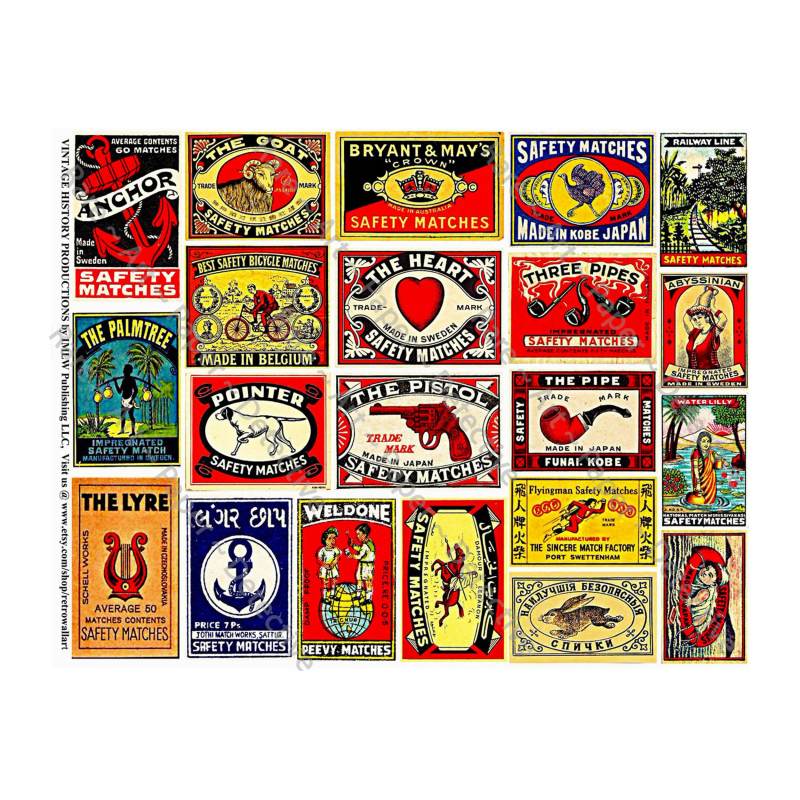
Matchbook; Indian Matchbox Labels By Datawala, Shahid
Stine, who works at Maryland Match Corp. since 1978, he witnessed this reaction firsthand. “In the first few years, in some major areas, it became increasingly difficult to convince restaurant owners that matches are still a way to promote their brand and image,” he admits. Stine is optimistic about Maryland Match’s growing sales over the past six years, but he is realistic. “It’s not what it used to be; it won’t be the way it was,” he says of the dating industry. “Our biggest challenge is convincing young restaurant owners that it’s the cheapest way to get your name out there. We’re no longer advertising it as a smoking gun.”
This fact is not lost on restorers like Tilden, who view this type of memory in a very modern context. “I never thought of them as an aid to smoking,” he says. But that doesn’t mean that no one smokes anymore. Stephen Stryjewski, chef and co-owner of Link Restaurant Group’s Cochon and Butcher in New Orleans, pointed to the “problem of excessive drinking and smoking here” that makes matches more popular, even though the city passed its first permanent smoking ban. impact in bars, casinos and clubs from next month. Regardless of the personal characteristics of his clients, Stryjewski believes that the big message justifies the cost. “It’s really not a lot of money,” he says of the product. “I like the sound it makes.”
Anderson, a former match seller who lives in Orange County and whose territory included much of the West Coast, remembers that “a lot of old people kept them because they realized [the product] was advertising,” he says. “Customers can’t smoke in restaurants, but they can smoke elsewhere. And that’s where you want them to find your matches.”
And the passion of collectors and pilumenist societies compensates for the loss of product ubiquity. Although laymen will use the terms “match book”, “match box” and “match” interchangeably, it is the one that is most important to the aficionado. Chester